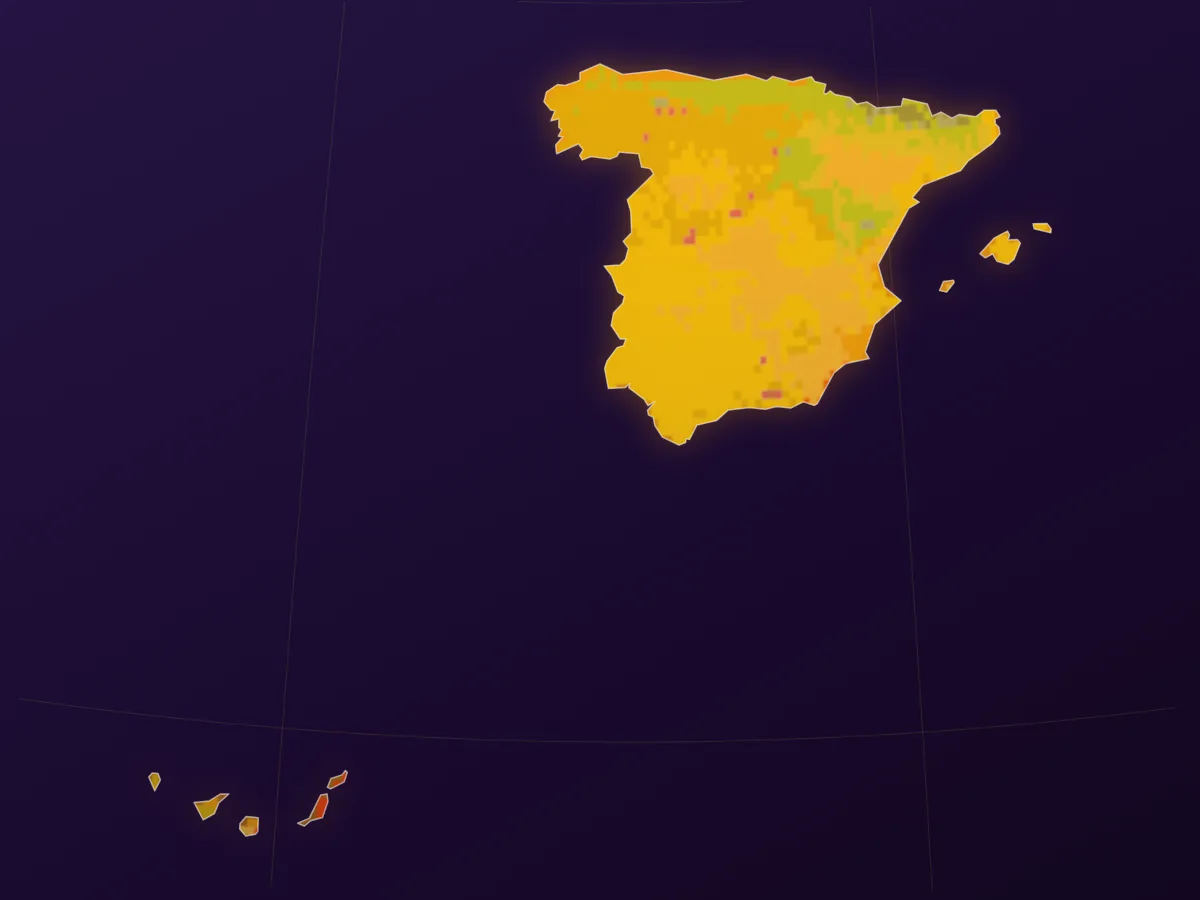

Financial estimates in disclosures
No disclosure standard asks for an expected annual damage as such. They ask for the amount and the share of assets, or of exposures, at material physical risk, broken down by kind of hazard, by place and over time. A financial estimate supplies the test of whether an asset is at material risk, the breakdowns and the scenarios. The amounts come from the reporter’s own books.
What the reporter adds
The carrying amount or gross exposure of each asset, the time horizons the reporter has set, and
its own adaptation measures. Public flood defences are already counted in an estimate, through
FLOPROS or the protection_rp given.
The fields
| Field | What it says |
|---|---|
material_physical_risk_flags[].material | The hazard is material at the asset: its expected annual damage reaches XDI’s moderate band |
material_physical_risk_flags[].family | Acute or chronic |
material_physical_risk_flags[].hazard_group | Temperature, wind, water or solid mass, the group of Appendix A to the Climate Delegated Act |
material_physical_risk_flags[].taxonomy_hazard | The hazard as Appendix A names it |
expected_annual_damage, damage_at_return_periods | Damage as a share of value and in money, low to high, and at the 50, 100, 200 and 500-year events |
scenario, year | Today, or RCP4.5 and RCP8.5 at 2050 and 2080 |
location.iso3, location.subdivision | The country, and the first-order subdivision with its ISO 3166-2 code |
Datapoint by datapoint
| Framework | Datapoint | Asks for | From an estimate |
|---|---|---|---|
| ESRS E1, Delegated Regulation (EU) 2023/2772 | E1-9, paragraph 66 (a) and (c) | Assets at material physical risk before adaptation, as an amount and a share, split into acute and chronic; their location | Which assets are at material risk (material), the split (family), the location (location) |
| ESRS E1, Delegated Regulation (EU) 2023/2772 | Paragraph 20 (b) | Hazards identified over the short, medium and long term, considering at least a high-emission scenario | taxonomy_hazard; RCP8.5 at 2050 and 2080 |
| ESRS E1, simplified (C(2026) 5010) | E1-11, paragraphs 39 (a) and 41, AR 32 | Carrying amount at material physical risk before adaptation, the method that decides it, the location aggregated faithfully | material and its published band, which is the method; location |
| ESRS E1, simplified (C(2026) 5010) | E1-2, paragraphs 16 and 17 | How exposure to hazards was assessed, and whether a high-emission scenario was among the scenarios | RCP4.5 and RCP8.5 at 2050 and 2080, low to high |
| IFRS S2 | Paragraph 29 (c) | Amount and percentage of assets or business activities vulnerable to physical risks | material defines “vulnerable”; expected_annual_damage in money |
| IFRS S2 | Paragraph 22 | Climate resilience assessed with scenario analysis | The scenarios and years, with their range |
| EBA Pillar 3, Implementing Regulation (EU) 2024/3172 | Template 5 | Exposures sensitive to chronic events, acute events or both, by sector, maturity and geography | family for the columns; location for the geography |
| EBA Pillar 3, final draft ITS of June 2026, not yet adopted | Template CRFR2 | The same, split into temperature, wind, water and solid mass, country by country | hazard_group; location.iso3 |
| EU Taxonomy, Appendix A to Delegated Regulation (EU) 2021/2139 | Climate risk and vulnerability assessment | The hazards of Appendix A, assessed over a range of future scenarios | taxonomy_hazard; the scenarios; the coverage of each of the 28 hazards at GET /api/v1/meta/methodology |
| TCFD guidance on metrics, 2021 | Table C1, physical risks | For example, the share of real assets exposed to 1-in-100 or 1-in-200 year hazards | damage_at_return_periods at 100 and 200 years |
Limits
- An estimate counts river floods, coastal floods and cyclone wind. Heat, drought, rain floods, wildfire, subsidence and the other hazards of Appendix A are not counted, and an asset at risk from them is not flagged.
- 2050 and 2080 are both long term in the ESRS sense, more than five years ahead. The short and medium term are the reporter’s to assess.
- The moderate band is XDI’s published scale, applied by Criora. No framework sets a threshold of its own: say which one was used.
- NUTS 3 codes are not given. The subdivision is the first-order one, which is NUTS 3 in some countries and coarser in others.
- The references were read on 26 October 2026. The EBA’s template CRFR2 is a final draft awaiting adoption, and the simplified ESRS apply from 2027, or from 2026 by choice.