+4.0 °C
Temperature
20502080
- Higher emissions SSP5-8.5
- +3.0 °C → +4.0 °C
- Lower emissions SSP2-4.5
- +2.3 °C → +2.6 °C
Hottest month +5.4 °C by 2080 (SSP5-8.5).


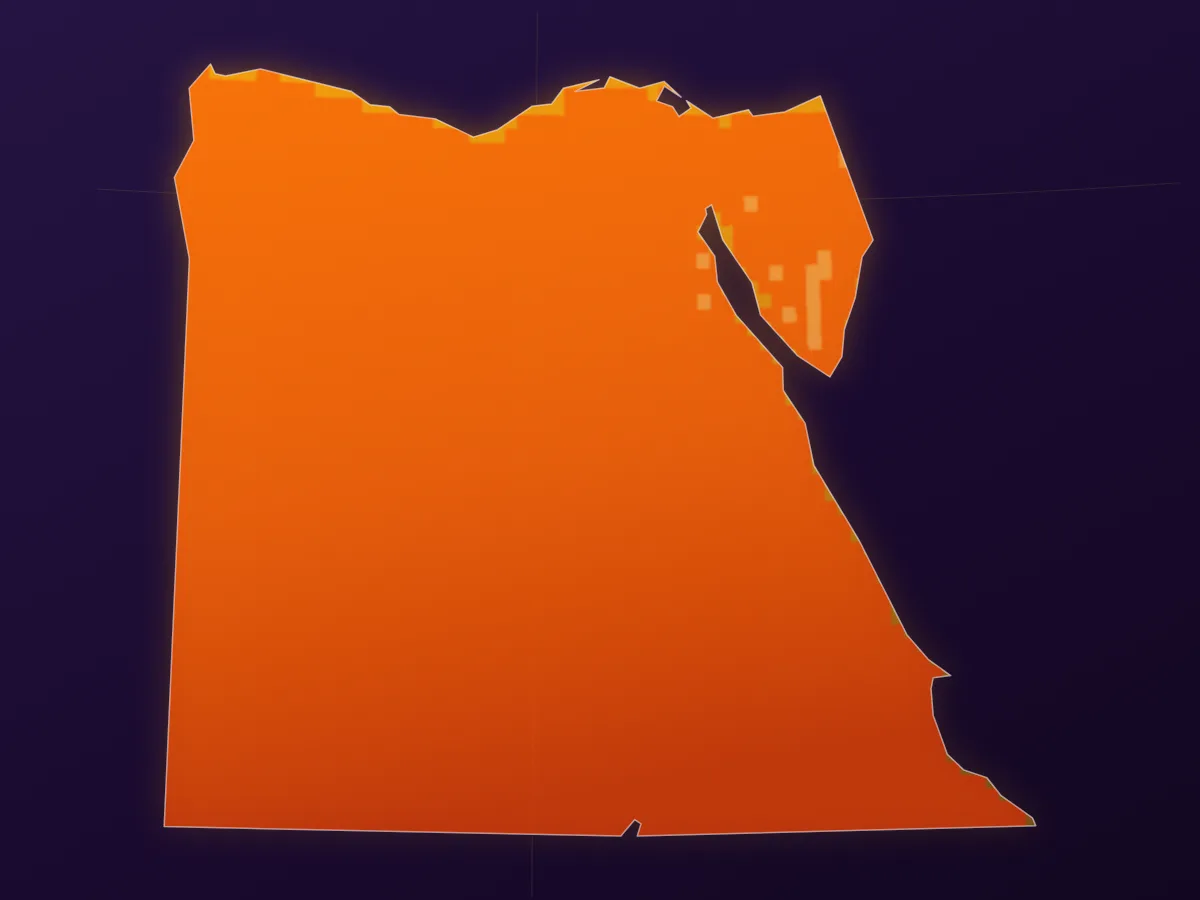
Egypt: mid-pack overall, with climate the main pressure.
The composite and its five dimensions. Higher means more risk.
Medium 56 / 100
Physical hazard intensity. INFORM Risk Index, 0 to 10.
Risk-ranked against its cohorts. Click any country to open its page.
Compare with any neighbour on all risks and their 5-year trajectory.
Projected physical change under a moderate (SSP2-4.5) and a high (SSP5-8.5) emissions pathway.
By 2080 under a high-emissions pathway, Egypt is projected to warm +4.0 °C, with annual rainfall changing 0 mm.
+4.0 °C
Hottest month +5.4 °C by 2080 (SSP5-8.5).
0 mm
Driest month 0 mm by 2080 (SSP5-8.5).
20%
Share of land under high or extreme water stress; 21% today.
1.4%
Land exposed to a 100-year river flood; 0.6% today.
Egypt: under high emissions, a 100-year coastal flood in 2080 could reach 8 of its largest cities.
Max depth: the deepest water within 12 km of the city center in a 100-year coastal flood in 2080, under RCP8.5 with high-end sea-level rise (95th percentile), ignoring flood defenses and land subsidence. Source: WRI Aqueduct Floods.
Regional estimate for the country's coast (IPCC AR6 median), not the global average.
Projections from public CMIP6 (WorldClim 2.1, 5-model median, against a 1970-2000 baseline), WRI Aqueduct 4.0 and IPCC AR6 data. Monthly and bioclimatic aggregates, not daily-threshold indices. Forward-looking estimates, not a re-scored site risk.
Every source-level indicator behind the dimensions above. Sort by score, value, or name.
Flood Risk | 9.90 0-10 | 99.0 |
Coastal Protection Needed | 97.3 % coast | 96.5 |
Fossil Fuel Consumption | 94.7 % of total | 94.5 |
Renewable Energy Share | 6.10 % of total energy | 93.7 |
Renewable Electricity Share | 12.2 % of total | 87.8 |
Land Surface Temperature | 36.8 deg C change | 84.6 |
Energy Imports | 9.25 % of energy use | 69.6 |
PM2.5 Air Pollution | 54.9 ug/m3 | 62.3 |
Cooling Degree Days | 4022 degree days | 55.1 |
Drought Index (SPEI) | -1.84 index | 19.8 |
Energy Intensity | 3.06 MJ/$2017 PPP GDP | 11.2 |
CO2 Emissions Per Capita | 1.93 metric tons | 6.1 |
Heating Degree Days | 854 degree days | 5.9 |
Energy Use Per Capita | 900 kg oil eq per capita | 5.0 |
N2O Emissions Per Capita | 0.19 kt CO2e per capita | 4.4 |
Heat Index | 2.81 index | 2.1 |
Access to Clean Fuels | 99.9 % population | 0.1 |
Coal Electricity Share | 0.00 % of total | 0.0 |
Freshwater Withdrawal Rate | 1.00 0-1 | 100.0 |
Forest Area | 0.05 % of land | 100.0 |
Freshwater Withdrawal | 7750 % of internal resources | 100.0 |
Population Below 5m | 0.99 0-1 | 98.7 |
Water Dependency Ratio | 0.98 0-1 | 98.3 |
Health Expenditure Per Capita | 0.92 0-1 | 92.1 |
Protected Areas | 11.6 % of land | 88.3 |
Agricultural Capacity | 0.73 0-1 | 73.4 |
Projected Cereal Yield Change | 0.71 0-1 | 70.6 |
Projected Climate-Related Deaths | 0.67 0-1 | 66.7 |
Projected Vector Disease Change | 0.66 0-1 | 65.8 |
Food Production Index | 109 index | 64.3 |
Dam Capacity | 0.62 0-1 | 62.3 |
Rural Population | 0.61 0-1 | 61.3 |
Tsunami Risk | 5.90 0-10 | 59.0 |
Age Dependency Ratio | 0.57 0-1 | 57.4 |
Projected Marine Biodiversity Loss | 0.53 0-1 | 52.6 |
Quality of Trade Infrastructure | 0.51 0-1 | 51.3 |
Earthquake Risk | 4.60 0-10 | 46.0 |
Protected Biome Areas | 0.45 0-1 | 45.1 |
Projected Hydropower Change | 0.45 0-1 | 44.9 |
Environmental Treaties Engagement | 0.45 0-1 | 44.5 |
Projected Biome Distribution Change | 0.41 0-1 | 41.2 |
Urban Concentration | 0.39 0-1 | 38.7 |
Projected Population Change | 0.37 0-1 | 36.6 |
Food Import Dependency | 0.34 0-1 | 34.0 |
Access to Improved Sanitation | 0.33 0-1 | 33.2 |
Projected Warm Period Change | 0.33 0-1 | 33.0 |
Agriculture GDP Share | 10.6 % of GDP | 29.5 |
Ecological Footprint | 0.26 0-1 | 26.1 |
Natural Capital Dependency | 0.26 0-1 | 25.7 |
Disaster Preparedness | 0.17 0-1 | 17.5 |
Child Malnutrition | 0.14 0-1 | 13.6 |
Projected Sea Level Rise Impact | 0.13 0-1 | 13.4 |
Threatened Mammal Species | 18.0 count | 9.4 |
Energy Import Dependency | 0.09 0-1 | 9.3 |
Paved Roads | 0.08 0-1 | 7.9 |
Projected Flood Hazard Change | 0.08 0-1 | 7.5 |
Natural Resource Depletion | 3.68 % of GNI | 6.4 |
Dependency Ratio | 0.05 0-1 | 5.0 |
Agricultural Land | 4.08 % of land | 4.3 |
Water Stress | 141 % | 3.7 |
Slum Population | 0.01 0-1 | 0.9 |
Forest Depletion | 0.11 % of GNI | 0.6 |
Projected Annual Runoff Change | 0.00 0-1 | 0.0 |
Projected Groundwater Change | 0.00 0-1 | 0.0 |
Electricity Access | 0.00 0-1 | 0.0 |
Tree Cover Loss | 18.0 hectares | 0.0 |
Hospital Beds | 1.13 per 1,000 | 92.6 |
Gender Labor Ratio | 21.8 ratio F/M | 85.1 |
Overweight Adults | 73.3 % adults | 78.6 |
Uprooted People | 7.70 0-10 | 77.0 |
Labor Participation | 45.5 % (15+) | 66.4 |
Net Migration | 305006 persons | 65.4 |
Primary School Enrollment | 90.3 % gross | 47.6 |
GDP Growth | 3.76 % annual | 47.5 |
Poverty Rate (National) | 29.7 % population | 46.8 |
Life Expectancy | 71.6 years | 46.2 |
Development and Deprivation | 3.90 0-10 | 39.0 |
Fertility Rate | 2.75 births per woman | 37.5 |
Shared Prosperity Growth | 1.95 % annual | 35.3 |
Adult Literacy Rate | 74.5 % | 35.1 |
Sanitation Access | 67.2 % population | 33.7 |
School Gender Parity | 1.00 ratio | 33.4 |
Aid Dependency | 3.10 0-10 | 31.0 |
Internet Users | 72.7 % population | 30.7 |
ESG Performance Score | 2.28 0-100 | 24.6 |
Unemployment Rate | 7.33 % | 20.6 |
Food Security | 1.60 0-10 | 16.0 |
Gini Coefficient | 28.5 0-100 | 14.2 |
Under-5 Mortality Rate | 17.5 per 1,000 | 14.2 |
Communicable Disease Deaths | 9.63 % | 13.1 |
Children Under 5 | 1.30 0-10 | 13.0 |
Undernourishment | 8.50 % population | 12.3 |
Aging Population | 4.97 % population | 9.8 |
Income Share Bottom 20% | 9.70 % | 7.0 |
Health Conditions | 0.20 0-10 | 2.0 |
Population Density | 113 people/km2 | 0.6 |
Access to Electricity | 100 % population | 0.0 |
Recent Shocks | 0.00 0-10 | 0.0 |
Patent Applications | 881 count | 99.9 |
Scientific Articles | 24025 count | 97.3 |
Voice and Accountability | -1.38 -2.5 to +2.5 | 77.6 |
Political Stability | -0.87 -2.5 to +2.5 | 67.3 |
Control of Corruption | -0.75 -2.5 to +2.5 | 65.0 |
Regulatory Quality | -0.67 -2.5 to +2.5 | 63.3 |
INFORM Governance Index | 6.10 0-10 | 61.0 |
Legal Rights Strength | 5.00 0-12 | 58.3 |
Women in Parliament | 27.5 % seats | 55.0 |
Government Effectiveness | -0.24 -2.5 to +2.5 | 54.8 |
Rule of Law | -0.18 -2.5 to +2.5 | 53.7 |
Healthcare Access | 4.00 0-10 | 40.0 |
R&D Expenditure | 1.03 % of GDP | 39.8 |
Physical Infrastructure | 3.40 0-10 | 34.0 |
Communication Infrastructure | 3.00 0-10 | 30.0 |
Disaster Risk Reduction | 2.60 0-10 | 26.0 |
Innovation (Readiness) | 0.04 0-1 | 96.2 |
Education (Readiness) | 0.24 0-1 | 76.5 |
Control of Corruption (Readiness) | 0.25 0-1 | 74.7 |
Doing Business Score | 0.31 0-1 | 69.4 |
Rule of Law (Readiness) | 0.37 0-1 | 62.7 |
Political Stability (Readiness) | 0.42 0-1 | 57.9 |
Regulatory Quality (Readiness) | 0.47 0-1 | 52.7 |
ICT Infrastructure | 0.50 0-1 | 49.7 |
Social Inequality (Readiness) | 0.69 0-1 | 30.6 |
These indicators have site-level resolution. Score your exact location.
Score a site in Egypt →The country score is an average. Get the full risk breakdown for one address or point inside Egypt.
Type an address, city, or landmark and we resolve it to a precise risk profile for that point.
Answer-first, drawn from the same data above.
Egypt: mid-pack overall, with climate the main pressure. Its overall risk score is 56 out of 100 (medium), blended from World Bank, INFORM Risk Index and ND-GAIN Country Index.
Egypt's highest pressures are climate (70, high) and adaptation (65). Its strongest area is social (38).
Egypt's climate zones stay broadly stable through 2080 even under a high-emissions scenario (SSP5-8.5); its Koppen-based climate-hazard pressure index holds near 66 out of 100. This forward-looking outlook is separate from the historical ND-GAIN scores.
Under a high-emissions scenario (SSP5-8.5), Egypt is on track to warm by +4.0 °C by 2080, with annual precipitation changing by 0 mm; under lower emissions (SSP2-4.5) the warming is about +2.6 °C. Based on CMIP6 multi-model projections against a 1970-2000 baseline.
Coastal sea level along Egypt is projected to rise by +0.76 m by 2100 under a high-emissions scenario (SSP5-8.5), and by about +0.53 m under lower emissions (SSP2-4.5). Based on the regional median of IPCC AR6 projections.
The share of Egypt under high water stress is projected to move from 21% today to 20% by 2080 under a high-emissions scenario (SSP5-8.5). Based on WRI Aqueduct projections.
The share of Egypt exposed to river flooding is projected to move from 0.6% today to 1.4% by 2080 under a high-emissions scenario (SSP5-8.5). Based on WRI Aqueduct riverine-flood projections.
Updated September 2026, drawing on World Bank, INFORM Risk Index and ND-GAIN Country Index.